Text developed from presentation by Arjuna Govinda
for Heart Flow Worldwide Spiritual Forum
Signposts ~ along the way to greater Love ~ A brief writing exploration as a reflection on my search to live in greater Love ~ some lessons learned, and some contemplations that have supported me on this Quest. From early awakenings to learning how to trust in life and whatever we might call ‘That’ which is behind it all. A Path that awakens me to acknowledge and welcome life in all its Glory and various challenges.
This exploration is in four main areas :
- First Awakenings
- Developing Perception
- Spiritual Consciousness
- Conclusion
FIRST AWAKENINGS
From a Source Divine I come into physical being … into consciousness … gradually realising what I am a part of, and the lessons that bless me … as I learn to accept, embrace, and celebrate, this precious gift we call ‘life’.
I imagine myself newly born, again in a physical form, challenged by the changes and at the beginning of learning to surrender again. But first, a need to learn about my individuality and apparent separation from ‘the One’. I go through my set of challenges as I learn who I am in truth and what I choose as I move forward in growth and learning. I am ‘me’ as well as ‘I Am’ but a part of ‘The One’.
A dear companion of mine, Tarajyoti Govinda, wrote in her book Becoming Whole: the psychology of Light : ‘I discovered that there was indeed a psychology of the heart. It was to be found in my own heart. I had looked everywhere, searched high and low; it came only when I looked within. There I found the map for my journey’ (p.xxx)
Early Influences
In a state of innocence I was, perhaps, first awakened through evocative music and some lofty ideas. Beethoven, Wagner, Mahler, Verdi, Purcell and Gregorian chants filled my childhood sensitivities with the hint of vast and glorious realms. Also with popular and folk music at the time, and then the fullness of voice and heart with Pavarotti and Andrei Bocelli. I was also stimulated by ideas that intrigued a child’s receptiveness and delight such as the possibility of Heaven and the unwelcome threats of Hell. I was also drawn into the more ethereal and deeply mysterious promises of Love Poetry from around the World, and a deep interest in the sheer wonders of nature.
In my informative years, I was inspired by many poets and artists of my generation. The 1960’s brought so many singers that filled my life with beauty, belief, and idealism. I was introduced to a more idealistic way of thinking in the beginnings of the Aquarian Age and along with everyone else, challenged to consider what we each choose and in the way we construct our modern world. Some artists such as Cat Stevens asked if we cherished the world and cared for it, on behalf of ourselves, our children and, in turn, theirs. On his music album Tea for the Tillerman Stevens asked ‘Where do the Children Play?’ Cat Stevens, Melanie Safka, Pete Seger, and others all asked of me ‘what is in your heart and what can you give to the well-being and benefit of all?’ Many other musicians inspired me to contemplate love, or passion, or the beauty of day-to-day life. Artists that were greatly influential including Elton John and Bernie Taupin, Leonard Cohen, James Taylor, Joe Cocker, Jacques Brel and many others.
Developing Ego
Around the age of seven I knew who I was and what I wanted in life. I was frustrated that many of the adults around me seemed lost in worrying about what other people might think, or many social rules, or just not as idealistic as was in my heart. I also observed how I was expected to take on so many of other peoples views and values.
Even after 70 years I am still not sure if it was partly because my father read me so many idealistic stories – or if it was just my own true nature that my father helped to bring to the fore. My father certainly taught me how to argue and opinion or perspective, and my innate passion often led me into conflict with others and eventually into walking the path alone for many years. I found it more peaceful to walk my own way and to leave others to theirs. I enjoyed being with people but I also required time-alone to be with my own thoughts and away from anyone who required of me to think like they did. My mind was somehow constructed differently and I needed to be sure to get my fill of just feeling inner peace.
Later in life, around the age of 25 and after a nervous collapse, I was introduced to the Swiss psychologist Carl Gustav Jung and his book Memories, Dreams and Reflections changed my life and understanding profoundly. In that book Jung wrote : ‘Loneliness does not come from having no people about one, but from being unable to communicate the things that seem important to oneself, or from holding certain views which others find inadmissible.’ It was awhile before I realised the degree to which my way of thinking was different to the way of the herd. I instinctively knew to avoid the way of herd mentality that had so negatively influenced the masses throughout World War II and many other times in history. I had no desire to go along with the crowd and find myself without full freedom to think and say what I believed in. It also took many years for me to learn to be cautious in what thoughts I expressed, to whom, and when. It was safer to simply think what I think and to find out what others believe before I confuse or agitate them in sharing my own.
Pressure, Control & Release
My youth and Aquarian idealism caused me to challenge the world where I found it wanting and experienced pushback on many occasions. People were not necessarily comfortable with me wanting for the world to change. Over time I redirected my efforts away from trying to convince others and gave my energy more to prayer as well as working on myself, and leave others to their own choices. As the ex-Harvard professor Richard Alpert, then known as Ram Dass wrote : ‘I can do nothing for you but work on myself. You can do nothing for me but work on yourself!.’ (Be Here Now, p.214)
As a teenager, as well as when in primary school, I felt like the Education system in my country, was pushing me to think in a specific way rather than guide me in how to think, or how to find my own path in life. What they were doing in the name of Education felt more like conditioning and programming and this extended into when I completed my Bachelor in Education and attempted to ‘teach’ in the system that I was confounded by. I did my utmost to teach the children about how to connect with who they were in truth but this was exhausting and seemed to be going nowhere. I eventually became exhausted from it all. Unhappy, dissatisfied and disillusioned, I gave up my position as a ‘school teacher’, left the mainstream and went walkabout.
Walkabout
I left a society that never made sense and left what I thought was to be my career as well. For some quiet time, I lived in the backyard of a friend’s house where I was able to setup a sanctuary for myself in an old guard’s-van. I purchased a disused train carriage that had a section I turned into a bedroom with a view and a larger open area that became my lounge and general room. In the back yard of an old mining cottage in a quiet county town, for brief time I found a place where I could break free from the restraints that had plagued my life until that time. I could let go of every rule and manner and restriction that had limited me until then. It was there that I shed my old skin and invited God Almighty to help me to begin again.
At the ripe young age of 23 I had abandoned my career and home and left everything behind. Travelling to Tasmania I eventually met fellow travellers who took me in and I lived in a one room cabin in the woods with several other people as well as others who came and went. As part of my recovery I read every single book I could find on Zen and penned line drawings. For a time this was where I could begin to heal. As is attributed to the poet and sage Rumi : ‘When you give up everything, everything is yours’.
Dark Times
Lost in anger and mistrust, I regressed from being a contributing member of society, losing faith in humanity which was only regained some decades later when I realised my trust had been misplaced. It needed to be given to the Divine Itself and inner government of the Earth. I eventually decided that we, as humans, evolve too slowly for placing my trust there but could begin to train myself to give my trust to the ‘All That Is’ (the Source and Instigator behind all of Creation).
On the road and then living alone for 5 years I studied all I could of Zen, Sufism, Taoism, I-Ching, and anything else that brought me closer to who I was in essence. The writings of psychologist Carl Jung, and my studies of Eastern perspective, were an essential support to my healing and return from self-exile.
A perspective I learned from Zen Master Hui Neng, from The Platform Sutra of the Sixth Patriarch was : ‘… One enlightened thought and one is a Buddha, one foolish thought and one is again an ordinary person.’ It seemed that, if I dedicated myself enough to training, that I might eventually train my mind to let go of judging everything and everyone, around and outside of it in some way, that I might learn and grow into becoming ‘a Buddha’ more of the time. I might even become enlightened one day.
Wonder-full Zen
From the moment of my break-down, the teachings of Zen gave me connection with what was more true for me than where society was at, and my level of consciousness, at that time. I was most fortunate to discover the teaching stories and practice of Zazen which helped me break through to new levels of perception and profoundly deeper sense of inner calm and intimate peace.
In Zen I was freed from some of the limitations and narrow mental constructs that had held me back before. The dear teacher D.T. Suzuki expressed it most eloquently in his introduction to Zen and the Art of Archery by Eugen Herrigel : ‘He thinks like the waves rolling on the ocean; he thinks like the stars illuminating the nightly heavens; he thinks like the green foliage shooting forth in the relaxing spring breeze. Indeed, he is the showers, the ocean, the stars, the foliage.’
Two poems I wrote to express something of my own journey in the unknown wonder :
New Lands
I enter now, into the mystery
of this dream, within a dream within … who knows what.
I journey, wondering, what will come
of stepping into new lands.
If you come with me, I will share what I find
and the feelings that try to persuade me.
A Light that beckons from the depths of my heart
I live on the edge of discovery.
On pathways that lead, to spaces that invite
some courage and will, and recovery.
I find a deep well, and the realm of peace
eternally present for all.
Miracles we share, though taken for granted
this wonder, this mystery,
in awe.
And …
Zen
I have no idea what to say about zen
except to share that it helped me
To regain my health
To restore some balance
to recover the peace
when there was none
Ready to leave
a frantic world
All by itself
Zen drew my return
Beyond mind
Beyond cares
Beyond worry
A lessened pain
I quit my job and went to the beach
Left my clothes with the shore
… and began again.
~ (2 poems) Arjuna Govinda / After the Storm
Psychotherapy Group
The study and practice of Zen carried me along for many years. Zen helped me to find my own inner core again. It also gave me signposts to lift my consciousness out of the corral-like ones that had created the breakdown in the first place.
Many years later, in deep illness and in a dream state, I was told that the breakdown had come from not being able to meet the expectations put upon me in my childhood and young adult years. Finally I had cracked under the pressure when I tried to work in a system that didn’t want my connection to Spirit or what I thought was valuable to serve the evolution of the human condition.
Leaving society was a necessity for me before I cracked and went mad without recourse. Sometime later I did experience that madness for perhaps half a minute or so and it was, to this day, the most scary thing I have ever experienced. I would warn anyone ever going near that place. The best way I have found to stay in the peace and beauty and gift of life is to regularly sit quietly and allow the blessings of life to flow through and upon you. To be present to what is and the Love and beauty in that.
After years of living alone, mostly in a cabin in the forest, I felt my time had come to rejoin society. I found a psychologist in the city and attended group sessions where we sat in a circle over ongoing weekends. In my initial session with the psychologist, I felt that, in one hour of listening, Susie heard everything I had been unable to express in 6 years of isolation. In one session I felt freed from needing isolation to being confident to join her group therapy circle for ongoing help and development. I could begin to find my place with humanity again.
A book that was being read by many in the group inspired me to read it as well and my life was changed by the very first sentence. The book was The Road Less Travelled by M. Scott Peck and the sentence was : ‘Life is difficult’.
Peck wrote :‘Life is difficult. This is a great truth, one of the greatest truths. It is a great truth because once we truly see this truth, we transcend it.’
I had taken on the belief that life ‘should be’ a particular way but I had not been able to accomplish that. I was giving my all to achieve something that others had convinced me that I should reach for but that was not my own dream or path in life. – it was something obscure to who I was in truth. Whatever those goals were, were not mine and I had been trapped in that. The acknowledgement that life was indeed ‘difficult’ released a major cultural belief within me that life ‘should’ be otherwise. I had been resisting truth and this release freed me in a profound way.
I am not recommending that “life is difficult” be taken on as a mantra but to acknowledge that truth that life is not only positive without negative. That earthly life has a duality, and that difficulties and challenges are equally relevant, and part of the gifts in life, as the more fun and easy going opportunities.
In Timelessness
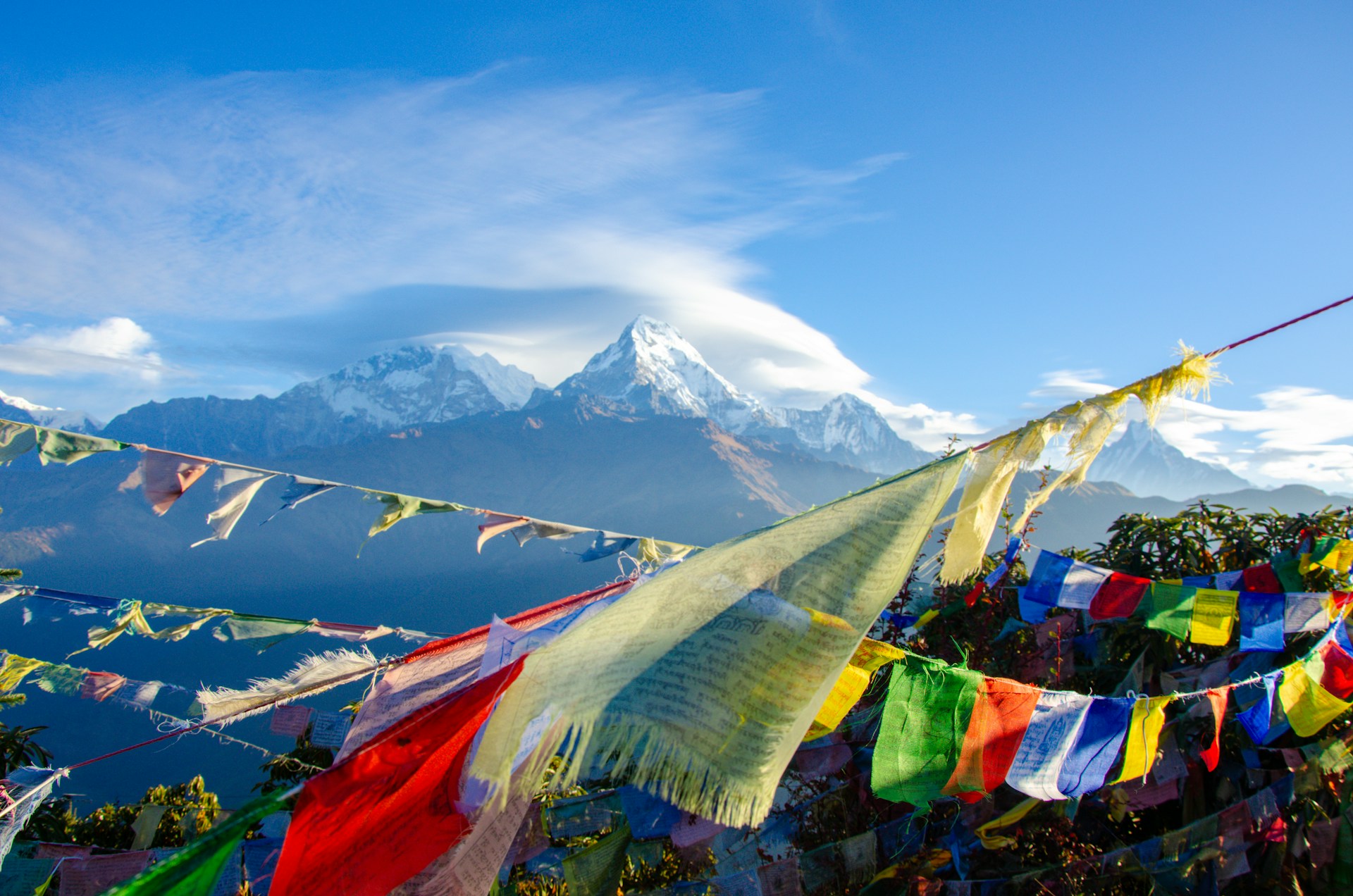
At the end of my sojourn in the forest cabin, I went to Nepal and climbed in the mountains and trekked the land for over 5 weeks. Setting myself a challenge to know that I could complete something and continue to work through the many unconscious fears that had residence in my unconscious mind.
On the way I met a more spiritually aligned aspect of myself, finding myself stopping mid river crossings, placing my hands into prayer position, and with closed eyes, bowing to what I felt there. On the first morning, in my hotel room before the trek, I opened the Bible and randomly picked a page. Continuing my random selection I placed my finger on the page and was surprised to read : ‘Exalt the Lord our God and worship at His holy mountain …’ (Psalm 99:9).
On the trek I often felt contact with Spirit as I left my old lifefar behind. I was no longer someone’s child or nephew or employee or other object of expectations, I was simply whomever and whatever I was in truth. Whomever and whatever I chose to be. I existed in relation to my sacred self and whatever contact I could find with Life and the Divine Itself. I was beginning to let go of all the previous restrictions on me and open to what the spiritual teacher Sri Nisargadatta Maharaj wrote : ‘When you want for nothing, then the Supreme state will come to you.’ (I Am That : talks with Sri Nisargadatta p.195)
DEVELOPING PERCEPTION
Awakening
Learning about oneself and especially about one’s higher Self, at some stage we get to recognise the way our ego-mind tries to get us to believe that “It” is what is most real. The ego-mind convinces us that it is the thing that is most important and around which the rest of life should serve. It is only over time and by Grace that we get to see how the ego-mind comes into being, where a group of thoughts form to develop a way of thinking; which this entity attaches to and projects as the ‘real world’, and then attempts to persuade its host to serve its survival and what it perceives of as its needs. One of the healthiest processes is when you become observant of the way your lower-mind behaves and you gain some perspective and freedom from it.
The ego diminishes as we become more and more aware of how it is behaving and it shrinks in what it demands. It also works at getting its needs met in a more subtle and nuanced way. Over time the ego-mind accepts that it is not in charge of centre stage and one’s heart and heart-mind in collaboration or Spirit may get to hold that central place.
Monkey Mind
Bhagavan Sri Ramana Maharshi in Marharshi’s Gospel wrote : ‘Peace is your natural state. It is your mind that destroys it.’ … and … ’The mind is a layer of thought obstructing the Real Self.’
To get back to this natural and peaceful state one only need be disciplined enough to stop from being overly active and allow oneself to sit quietly, breathe relaxedly, and observe what is actually going on. You have the chance to experience this natural state of peace when you are not constantly active and with an outer focus, and instead, go within.
One way to experience the Real Self is to stop allowing the lower ego-mind so much control and look past this lower-attachment to worldly things. As is says in the Bible : ‘Seek ye first the Kingdom, and all else shall be added unto you.’
Another way to lessen the control of the lower, monkey-mind is as the Third Zen Patriach taught : ‘If you wish to know the truth, only cease to cherish opinion.’
Acknowledging One’s Shadow
Another very freeing practice is realising something of the degree of one’s unconscious matter. To recognise that we all store aspects of our personality (lower ego) selves away. This includes aspects that aren’t accepted by family, community, society or ourselves. We store away our less refined aspects as well as our inner gold. Integrating these aspects back into conscious mind and body, strengthens us in our full truth as well as releasing the energy that it took to store or suppress them in the first place.
Quoting and paraphrasing C.G. Jung : ‘One does not become enlightened by imagining figures of light, but by making the darkness conscious.’ and ‘Until you make the unconscious conscious, it will direct your life and you will call it fate.’
The Practice of Meditation
The practice that originally changed my life the most – and freed me up from thinking that I was ‘my ego’, was the practice of Zazen. Sitting quietly, being present to what is, and just observing the processes of life.
The poem that brought me first realisation was Zenrin-kushu : ‘Sitting quietly, doing nothing – Spring comes, and the grass – Grows by itself.’ It was this one poem that greeted me to a new paradigm after my nervous breakdown at age 23 and opened me to realise the truth that lay waiting for me when I would let go of previous beliefs that I had been programmed to hold on to and perpetuate. I was becoming free of some of my previous programming and released to enjoy the beauty and blessings that were held in these inspirational poems.
Later in life I read a recommendation from Paramahansa Yogananda’s teacher, Sri Yukteswar : ‘Outward longings drive us from the Eden within; they offer false pleasures that only impersonate soul happiness. The lost paradise is quickly regained … through divine meditation.’ (Quoted in The Autobiography of a Yogi)
Ram Dass, formerly Harvard professor Richard Alpert, describes the process for him : ’At the moment when there’s nothing more to lose, the Ego breaks open – and then we see who we are behind who we thought we were.’ (Polishing the Mirror, p.65)
I have now been meditating on a daily basis for the past nearly 50 years and it makes a profound difference to my experiencing of the quality of life. I am not entirely free of the tricks of the lower-mind but free enough to get some space from the dramas bought into when believing what that ego-mind insists upon. I am more often than not able to be present to the Eternal Gift while calming a busy mind.
Going within, into the inner truth is where I best connect with what I most need to know in this very moment. Other times I need the added help of healers or friends.
Learning to Let Go
I am blessed by the grace and wisdom of those who have come before me. So many dear teachers and teachings that support us on our Way.
Lama Choedak, when relaying a message from H.H. 14, the Dalai Lama, said about laughter which also relates to letting go : ‘Laughter is actually learning how to move on, and not blame the river which drowned your shoes last year.When that river is not there. That river would have long gone, and merged with the main ocean.’ (Unknown source)
Yogananda in To Be Victorious in Life (p.60) suggests : ‘Train the mind to remain neutral to every condition.’
The Gift of Acceptance
Another practice that I find very freeing is in accepting life exactly as it is. Another gift from the practice of Zazen. My early lessons included learning to accept the differing perceptions in paradox. There was also a sense of peace in learning to accept that life has contrast and duality and that life requires movement and change. Without such how would life, as we know it, exist? Day and night, activity and rest, endeavour and surrender, consciousness and sleep.
I am supported in this by recalling the modern phrase : ’The best thing one can do when it’s raining is to let it rain’. Or as Yogananda puts more precisely in his collection of lectures, Journey to Self-Realisation (p.382) : ‘God sends to you those experiences you need, that you might profit by them.’
SPIRITUAL CONSCIOUSNESS
A Spiritual Path
How long do we live this life compromising, or in some degree of suffering, as we ask ourselves why we are here and if there is a greater mission calling us to respond to. Henry David Thoreau in his book Walden suggested that : ‘The mass of men lead lives of quiet desperation.’ Yogananda again, in Journey to Self-Realisation is more specific. Yogananda writes : ’Millions of persons die of broken hearts, having tried vainly to find in worldly life the fulfilment that exists only in God, the Source of all Joy.’ Perhaps another way of saying this comes from a modern day teacher named Sadhguru. Sadhguru suggests that : ‘The need for meaning is only of the mind. Life has no need for meaning. You are alive – that’s beautiful, and that’s it.’ And … ‘If you realise that you are part of the existence, your life will come to an absolute sense of ease.’ Sadhguru seems to suggest that it is only our mind that seeks answers and meaning, etc. He suggests that it is enough to simply open to the fact that we are a part of this vast manifestation and in this we might find what our minds are looking for. Again, as Yogananda wrote : ‘… the fulfilment that exists only in God.’
After a long journey of indulging myself in many worlds pleasures, around the age of 33 at a spiritual level, I was ready for more …
Meeting My Teachers
Early in 1988 I met Tarajyoti Govinda in whom I found a teacher, guide, and life-partner. I had little direction in life and it felt to me that Tara was very clear in how she was serving in the world. I felt inspired to become her helper and co-worker and did so for the next ten years. Tara was also attracted to travel with me and insisted I first met her teacher, Ananda Tara Shan. In meeting Ananda I felt I had finally met a true authority and was pleased to meet and work with both Tarajyoti and with Ananda.
One thing I learned at this time was that a true guru will guide you to follow your own inner knowing which Ananda always encouraged me to do. Ananda radiated love as well as clarity of knowledge and understanding of what I would call a spiritual Way.
Ananda wrote, in her booklet Fears and Depression, ‘Spiritual development means purifying the personality and building into it qualities that are positive and one with the purpose of one’s soul.’ (p.11) and … ’Everything becomes spiritual when it is done in peace and harmony.’ (p.28)
Getting to Know the Truth
In The Living Word of the Hierarchy, Ananda wrote :‘You must face your dharma with stoicism, for it is yours, created by your actions in former lives, and it contains the lessons you need to progress in your soul evolution. In one embodiment you will go through several periods of physical, emotional and mental hardships. You can make these periods difficult or manageable by your cooperation and your willingness to learn from them.’ (p.167)
Life can bring many challenges and it has helped me to cultivate a mindset and trust that what may come, comes because of something I have created in the past. It may also come because there is some lesson that I am to learn. The more I can trust in a sacred structure to Life Itself, the more I can begin to relax and open to how I might face each challenge as it does comes. Once I can trust that something is happening ‘for’ me and not ‘to’ me, the more I can look for a solution rather than get stuck in suffering the ‘problem’.
From the day Tarajyoti introduced me to Ananda, I felt to stay around Ananda and learnt many things from doing that. I also learned that the Spiritual Path gave many gifts, albeit often learned in a challenging way. I learned that the Light that one invites into one’s life also invites deep and challenging transformation. That Light shines a light in the darkness and that darkness needs to be cleansed and integrated in order to gain strengths from those encounters/lessons.
In the talk Ananda gave on Fears and Depression she said : ‘No person can stand before the Throne of God and remain stagnant and unchanged. The closer a person reaches into the light, the more conflict and turmoil he or she may be confronted with in the inner life as well as the outer life.’ (p.3) Tarajyoti Govinda in Becoming Whole : the psychology of Light : ‘Essentially it is through conflict that we find our wholeness.’ (p.51)
Working with Tara
Some of what I learned from working alongside Tarajyoti included taking full responsibility for my choices in life, and to ‘give without counting the cost’.
One of Tarajyoti’s writings in her book Becoming Whole : Tarajyoti writes that : ‘the journey towards wholeness can be a rich one. It involves accepting ourselves and allowing ourselves to be. It also demands a certain diligence and desire to better ourselves, not in terms of outer success, though that may come, rather, in terms of aspiration to live in Light, integration of our shadow and the manifestation of an inner peace which comes through living in truth and love.’ (p.281)
For ten years I worked day and night with Tarajyoti and after some years I wrote a poem to express my development in that lifestyle.
‘Every day, less sleep,
Every moment, closer to God.’
In 1999 Tarajyoti passed into Spirit and she was greatly missed by many. Her legacy included helping many through deep transformations and educating in the synthesis of psychology and spirituality.
Tara’s passing
Tarajyoti’s passing was devastating to me on many levels and took a great deal of effort to work through the shock, confusion, anger, depression and sense of loss for many years after. In some respects I am still negotiating the choices I made at the time some 26 years later as I seek to continue my journey on the spiritual Way.
One of the main points I focused on to make some sense of the Tarajyoti’s early passing was a Sufi poem. This Sufi teaching helped lift my thoughts from getting lost in feeling too sorry for my personality self : ‘When the heart weeps for what it has lost, the soul rejoices for what it has found.’ It didn’t take away the deeper tasks I have had with the experience but helped me to have a focal point to assist in my task. Another method I used was to listen to Andrei Bocelli singing ‘Sogno’ at full volume wherever I went. The intensity of the song and the depth of heart in Bocelli’s voice gave me a form to let go of the enormity of feelings within me. As I listened I was able to feel something of what I needed to be present to.
In the depths of angst and sense of loss I needed to keep lifting my thoughts to higher places, as well as manage dark and wayward feelings. I needed to work through the pain to open to, and connect more with ever greater Love and Truth. This was possible somewhat through meditation but also through being kind to myself, making space for the time to heal, and doing what I could to surrender to the higher purpose of such a drastic and unexpected change. The sentence in the Bible was quite pointed about the whole thing : ‘The lord gives and the Lord taketh away.’ That was my lot in life and will take the time it takes to fully process such.
Ananda Teachings
Both Tarajyoti and Ananda helped me to realise the need for shifting my ‘personality’/ ego-mind from a central place to allow for more awareness and Spirit to reside there.
In The Living Word of the Hierarchy Ananda writes about some of the qualities needed for walking a spiritual path. Ananda writes : ’Tread the Path of pain with fortitude, and know that pain and suffering bring God’s Love upon you. To bear your suffering with joy and understanding bestows upon you immortality. You become a chalice with the sweetest smelling wine, the wine of immortality.’ (6 November 1992) Of course, knowing the map for the journey and actually walking it are two different levels of experiencing life.
Ananda’s Passing
Ananda passed into Spirit 3 years after Tarajyoti which brought me more grief, confusion, sense of loss, and need for resolution in personal adjustment. This adjustment took me at least 10 years as I let go and adopted what I could of the gifts they each had given me.
Over time I came to the conclusion that I had been given so much in my time with Tarajyoti and Ananda that I had quite a task to make sense of the changes and create a new life. I am reminded of the phoenix rising from the ashes of a fire. First came the fire and intensity of the challenge, then an adjustment to the tasks ahead, then the will to move forward and see the tasks through. A helpful reminder of the way through a crisis came in the saying : ‘If you are going through hell – then keep going!’ (Anon). Ananda had supported me when Tarajyoti passed with the mantra ‘Never give up’. I reworded this for my own psyche as ‘Always keep going’.
It was during the aftermath of Tarajyoti and Ananda’s passings that I put together a memoir titled Towards the Lion based on the quote from the sage Rumi : ‘The step in the presence of the Lion, towards the Lion, is a great and rare matter. This is the true step in a human life, the rest are mere footprints.’ (In Fihi Ma Fihi, Discourse 26)
In more simple terms I remind myself : ‘just go to God’.
Aftermath
At times, almost unable to continue to find joy in life, I reflected on my existence and what I had been through. I noticed how over a 21 year period I had come full circle and it looked liked what is known from Joseph Campbell’s work as The Hero’s Journey. A Journey where the ‘Hero’ responds to an inner call and goes through various tests and trials to reach their karmic alignment. I observed how I also went through a similar cycle over shorter time frames. As Campbell describes it, the Hero is : ‘… someone who has given his or her life to something bigger than themself.’ (Quoted in The Hero’s Journey by Christopher Vogler)
Another teacher I came to admire was Ram Dass who inspired me with his saying : ‘I would like my life to be a statement of love and compassion – and where it isn’t, that’s where my work lies.’ (One-Liners, p. 52)
A poem I wrote to express my endeavours during this time :
‘I do what I can to tread the way,
to become the kindness, that counts not the cost.
So I fill these years, in my practice, seeking peace;
And learn to befriend,
this heart of mine.’
~ Arjuna Govinda
Death
So, with the death of my two closest teachers in Tarajyoti and Ananda, my heart and psyche were challenged, leading me to believe that anyone close to me would likely die suddenly and without any warning. Death became a major theme in my seeking to understand life and why we make any effort at all if our guaranteed conclusion is to pass. I studied many holy books to put my mind at ease as well as working with a psychological weakness and defeatist attitude of “why Bother!” Between studies, and healings, and the passage of time, I eventually found some peace and encouragement to keep going, and work at trusting life to unfold according to a divine Law.
In Yogananda’s Autobiography of a Yogi, Lahiri Mahasaya is quoted : ‘Remember that you belong to no one and that no one belongs to you. Reflect that some day you will suddenly have to leave everything in this world –so make the acquaintance of God now.’ (In Chapt.35)
While I am most blessed to now share my life with my wife and very dear friends, I am also aware from the experience after Tarajyoti’s death that I needed to learn to be able to walk alone. In truth I believe that we are never alone, with angels helping us along the way and elder brothers and sisters supporting us in Spirit, we are nonetheless required to experience that we are just us and God at some stage along the Way. Perhaps, at some stage, our perception progresses to where our sense of personality/ego-self ceases to exist at all and there comes a realisation that we are one with the infinite God Itself. Once the illusion of being bound to the earthly realms is broken, greater connection with Source is found, then every other experience knows its place.
For me, it is like I learn how the river flows and that there is nothing I need to do for it to continue to do so. That I am not in charge of anything other than my learning to let go, and to place my trust in Life Itself – the one true Source beyond all manifestation.
Kabir, the mystic poet and saint, asked some very pertinent questions in his poem : ‘Can you tell me who has built this house of ours? And where do you hurry to before your death? Can you find the thing of true value in this world?
Another great saint, Sri Ramana Maharshi offers us : ‘Let come what comes, let go what goes. See what remains.’ (Talks with Sri Ramana Maharshi)
I have studied what the saints have shared about the continuity of life and the unfounded fears we have around death for many years now and recently I heard the most succinct comment on life and death. It comes from the dear teacher known as Mooji. Mooji says : ‘You only live once – but it is forever.’ (See www.mooji.org)
CONCLUSION
So, from my perspective, though the spiritual Path brings many blessings, it is also a difficult path to walk. It requires constant decisions that lead one towards a greater consciousness as well as cleansing and strengthening one’s connection to heart.
Ananda Tara Shan in The Living Word of the Hierarchy suggests : ‘With good spirits and humour you will overcome all obstacles that you or God have placed before you. With joy, the Soul descends, and so you can bear the suffering of earthly existence, supported by this joy. Make laughter your tool to walk the Path. Laugh even when it hurts.’ (p.47)
Cosmos
As a broad perspective and further support for me walking a spiritual path, I remind myself of Paramahansa Yogananda’s quote in Man’s Eternal Quest. Yogananda writes : ‘The factory behind creation is beyond imagination; the whole universe is a single thought in the mind of God! So simple, yet the galaxies are guided by mathematics inconceivable by man. Everything runs in perfect order. What tremendous intelligence is manifested in creation! The infinite is working in everything. All the different eddies of motion called life are controlled by that Cosmic Intelligence.’ (P.257)
And Ananda : ‘ … Belief in God, faith in God, oneness with God, will lead you to the perfect middle path, and one day you shall become the consciousness of that path and yourself become the Path.’ (The Living Word of the Hierarchy, p.150)
So, the best I think that I can do, at this time, is to cultivate calm, remain in this very moment, and keep my heart and mind in a state of trust and wonder. To listen to my heart, and as able, to make my choices from my heart-mind with soul together.
The teachers that I feel I can trust, and my own inner intuitive nature, guide me to make best choices while, at times, enjoying the support of inner inspirations.
I also do my best to take time to feel what might be the most right and best options.
Not what my ego-mind wants and craves but what Spirit guides me towards.
In this very moment, to hear what my heart says and acknowledge this incredible gift of being, consciousness, and in relative bliss.
In gratitude, Namaste.
Arjuna Govindamurti
Epilogue
‘Such is life
7 times down
8 times up.’
~ Japanese proverb (Original ~ ‘Nana korobi ya oki’)
‘Silence is the language of God. All else is a poor translation.’
~ Anon
‘Let silence take you to the core of life.’
~ Rumi (from poem One Whisper of the Beloved (trans)
Text developed from presentation by Arjuna Govinda
for Heart Flow Worldwide Spiritual Forum
Recommended Reading
Ananda Tara Shan. The Living Word of the Hierarchy
Berke, J. I Haven’t Had to Go Mad Here
Das, K. Chants of a Lifetime: searching for a heart of gold
Dass, R. Be Here Now
Dass, R. Paths to God : living the Bhagavad Gita
Frankyl, V.E. Man’s Search for Meaning
Gibran, K. The Prophet
Govinda, T. Becoming Whole : the psychology of Light
Govinda, T. The Language of the Heart : is spoken all over the world
Govinda, A. After the Storm
Govinda, A. Towards the Lion
Harvey, A. The Way of Passion : a celebration of Rumi
Herrigel, E Zen and the Art of Archery
Hyams, J. Zen in the Martial Arts
Johnson, R.A. Owning Your Own Shadow
Johnson, R.A. Inner Gold
Jung., C.G. Memories, Dreams and Reflections
Katie, B. A Thousand Names of Joy
Kornfield, J. After the Ecstasy the Laundry
Kornfield, J. The Wise Heart
Lao Tsu, The Tao Te Ching
Mafi, M. Rumi. Day by Day
Peck, M.S. The Road Less Travelled
Susuki, S. Zen Mind, Beginner’s Mind
Vogler, C. The Writer’s Journey
Walsch, N.D. Conversations With God, book 1
Yogananda. Autobiography of a Yogi
Yogananda. Journey to Self-Realisation
Yogananda. Man’s Eternal Quest
Yogananda. The Divine Romance
Yogananda. To Be Victorious in Life
My Websites
www.devawings.com
www.musicheartjourney.com
www.innerwork4men.com